

Do you take the right track in your presentation, or do you get lost?
When you give a presentation, you need to choose the right route for your audience. If you start at the wrong point or take the wrong path, even a well-prepared presentation can lose its impact. Connecting with your audience is therefore one of the most important elements of effective presenting.
Interestingly, this is not so different from preparing a real journey.
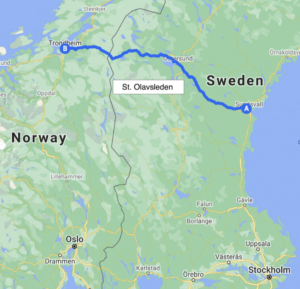
This summer I am going to hike the Sint Olav’s trail.
This is a 580-kilometer old pilgrim’s trail that starts in Sundsvall Sweden and ends in Trondheim Norway. The path goes over mountains, through forests, along lakes and historical sites. I cannot wait to be outside all day and spend my time in nature.
I am already in the process of preparing myself for this trek. I have read 2 books, to already get into the mood. 1 kind of logbook of a woman who did the trek in 2017 and a real practical guide. Unfortunately, this guide only exists in German. Now, I have to google words like “schutzbezog” and “trubel”. But that does not lessen my enthusiasm. In short, the route is chosen and is being prepared.
Like me, you also must select your route when you present. You need to know where your audience is now, spot A. And where exactly you would like to take them, spot B. And which steps are needed to get them there and if this will fit within the timeframe.
Because depending on where your audience is NOW, will determine if you are going to predominantly walk the HOW or the WHY route with them.
That this orientation is key for the success of your presentation is something that Thomas experienced first-hand.
He assumed that his audience still needed to be convinced about his plan and approach. That is why during his preparation he had put a lot of time into this. He added different models, graphs, and a lot of other theoretical substantiation for his approach (WHY). One thing led to another and before he knew it, his presentation had expanded from just 15 minutes to more than 40.
When Thomas finally presented his plan, he gradually noticed that his audience was already convinced about the WHY. A brief outline in his introduction would have sufficed.
The audience was eagerly waiting for the HOW. They wanted to roll up their sleeves. They had a need for examples from others that went before them. How did they put it into practice? What was crucial in making it work?
They could do without this long, dry, theoretical story full of models and figures. Because they were already a step ahead.
Thomas could feel whilst presenting that he was not connecting with his audience. And that his presentation, where he had worked on for hours, was not finding receptive ears. As soon as he noticed that he was losing grip, he started compensating this feeling by speeding up, trying to end this 40-minute presentation as quickly as possible.
I can tell you, it is really horrible to present like this! You attempt to put a large elephant (content) in a small box (presentation). And on top of that, the audience is not waiting for this particular elephant. They wanted another one! You get nervous, you speed up, you feel that everything is slipping through your fingers. And the minutes seem to last like hours.
We all have been there!
He had put so much effort in his presentation. He was a real expert and pro, because he knew so much. However, his message did not come across, because he simply did not connect to where his audience was. He started in the wrong spot and had chosen the wrong route!
Are you also an expert, that knows a lot about your field and has a lot to share? Do you also sometimes have the feeling that you do not connect with your audience? That you are losing your grip while presenting?
Do you want to learn to get more grip? Do you want to learn how to connect better to your audience?
So, you do not have to spend hours of work on your presentation and also feel more equipped and confident?
Do you recognize this?
Are you an expert in your field with a lot to share, yet sometimes feel you are not fully connecting with your audience while presenting? That you are losing grip on your story?
Learning to choose the right route for your audience can make a big difference. With the right preparation and structure, you can present with much more clarity and confidence.
If you would like to work on this more thoroughly, you can read more about my presentation skills training and coaching here, where we focus on designing and delivering presentations that truly connect with your audience.
Kind regard,
Mabel